Initial Draft
A New Take on the Fall of Man
René Girard pioneered the theory of Mimesis – that we do not look within ourselves to define the scope of our ambitions but to one another. To Girard, the travelers struck blind with envy in Dante's Purgatorio were expressing something fundamental to human nature. We are all, therefore, strangers to ourselves except insofar as we identify within ourselves the refractions of the reflected light of others.
But is this mimetic destiny inevitable? Does it fully circumscribe the range and scope of human relations and ambitions? Is humanity trapped in a closed system of imitation or can we exceed Nietzsche and not only "shoot the arrow of longing beyond ourselves" but also above the maddening din of the desires of others.
To look beyond our time, I must cast our eyes far back to an age of myth. To us moderns, this might seem misplaced. After all, we worship science and shun lore. The Fall of Man, the Theft of Fire, the songs of Bronze Age warriors. Are we not above such petty superstitions? Tales of elves and gods, mythical serpents, and frat boys drunk on mead?
This is a treacherous path. Unless one painstakingly combs these texts, we may be easily misled. In modern transliterations and you’ll see names and words that appear that aren’t in the original. After all, our modern academics know better than the ancients what they intended to say. So the passing of the generations renders these tales, through a game of telephone, unrecognizable, continuously reappraised to be suited to modern eyes that would cast at them a dismissive glance.
But if we are willing to be something other than modern, something that like the mythological Janus has an eyes facing both forwards and backwards, we can see new views that neither science nor lore would unveil on their own. And in doing so, perhaps we can look at the human condition with new eyes and see farther along the horizon of human potential.
Let's start with the Fall of Man - you know the tale. Adam and Eve are in a Garden until they are tempted to eat a forbidden fruit from the tree of Good and Evil. Then, struck by shame at their nakedness, they escape the garden. Our modern sensibilities scoff — how is the knowledge of good and evil a bad thing?
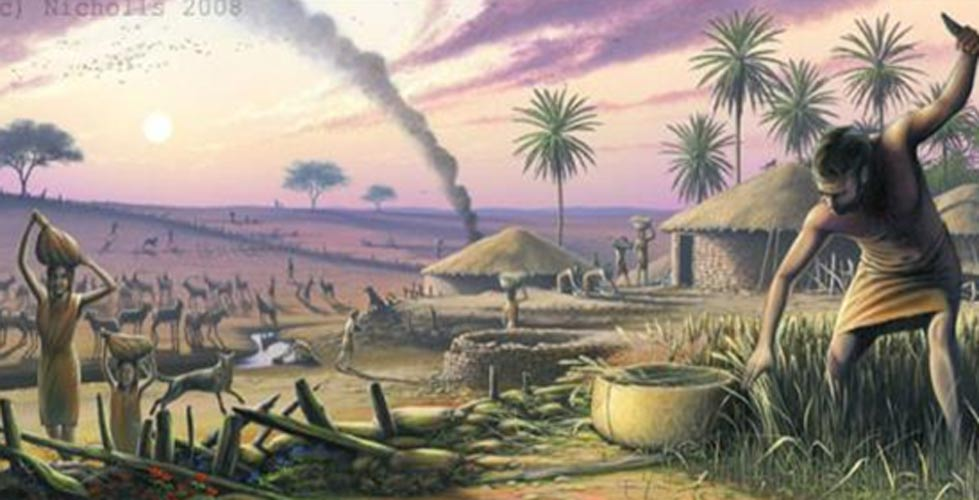
But are we seeing the original version of this story? Ask the Yazidis, a pre-Zoroastrian Iranian people who remember the forbidden fruit as wheat and their farming ancestor as Adam or the Sufis who remember “a grain of wheat eclipsed the sun of Adam.” Mistranslations have given us some strange belief that the fruit was an apple, but if we apply some basic phylogenetic bracketing to this story, we see wheat emerge again and again as the forbidden fruit and come to see it is an echo of a story we know from the archaeological record — the domestication of agriculture.
We hear this from two divergent perspectives in the mythic record. A figure is remembered who offered this gift to Adam, Shaitan to the Abrahamic faiths, the Peacock King to the Yazidis. To the Judiac tradition, this decision to cultivate wheat is the source of all human ills and Shaitan is cursed. To the Yazidis, it was a good thing — it allowed for writing and cities, metallurgy and mathematics. It allows Abraham's descendants to be as numerous as the stars and be fruitful and multiply.
To our modern frame, it seems the Yazidis had a point. David Graeber does some great research on this — the first farmers were innovative and tinkering and delightfully egalitarian. Farming societies spread across the Old World — from Ireland to Japan, from Sri Lanka to South Africa. And thanks to farming, the land can now support orders of magnitude more people
But the bricks, the bones, and the tablets of these societies whisper a chilling tale. In the genetic record we see societies either commit genocide against the hunter gatherers or establish a brutal caste system over them. This caste or class is defined by blood and we see incestuous unions among royals of Old Europe. In India, in both the Indo-Aryan north the Dravidian south, and among the Yazidis, we still see the endogamous marriage groups and hierarchy defined by birth.
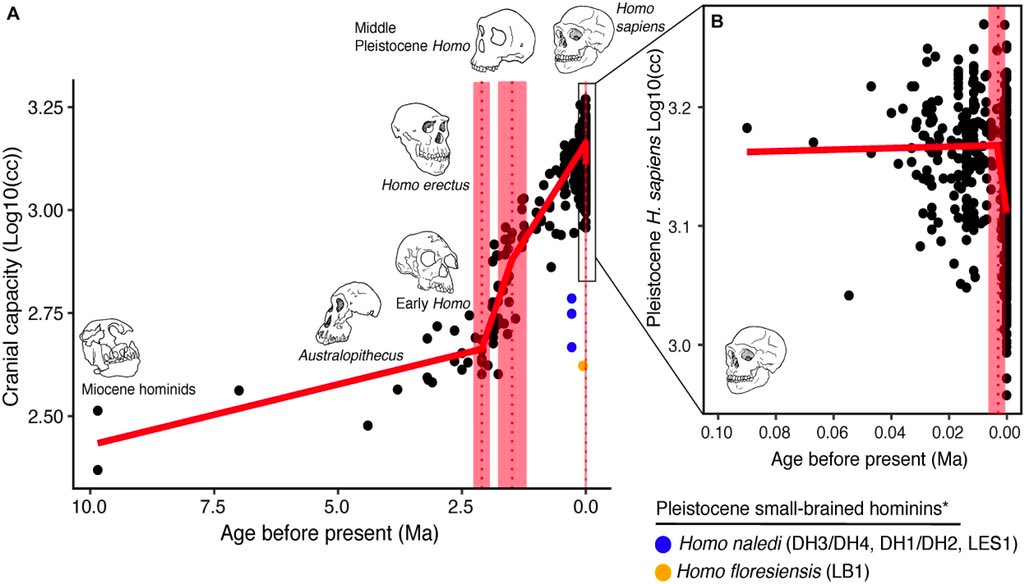
Their laws and religion follow a similar template — a priesthood prescribes a divine orthodoxy, upholding a sacral state. Violence is prescribed against murder and theft, but also female expressions of sexuality — through stonings by delighting mobs. Most disturbingly, while the range of human brain size remains constant, the distribution skews increasingly to those of smaller and smaller brain size. We thought Idiocracy was a story of our future, but it seems it was the story of our past.
Why? Humans became mimetic — those who mindlessly repeated custom and extinguished their curiosity were better suited to till the soil in an endless cycle year after year, rooted to a single place. Girard captures these impacts well: we no longer sought the horizon, but the things of our neighbor; we no longer knew what we desired, we copied it. Tinkerers became traditionalists. And when mimetic tension grew too strong, this tension was resolved through violence, violence against the deviant and excellent, often on trumped-up charges.

The Satanic turn brought us genocide, caste hierarchy, violence against female sexuality, orthodoxies and priesthoods, but also in the humans of its creation it instilled a deep and powerful drive — to destroy the excellent and the deviant. Because those are the people who might bring something new, something that changes the game, and our fallen humans can no longer adapt. The new domesticated humans believe that obedience will bring paradise in another world and that outliers must be destroyed in the present one.

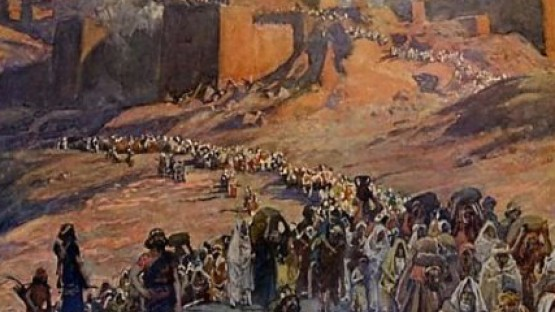
But Satan’s mark was not universal. The Judaic tradition is remarkable in that alone among the people of the region, they reject this provenance. They attempt to fight this legacy and in exchange, they are cast about the circumference of the Earth, forever wanderers, forever persecuted for their refusal to bow to the Satanic complex, and ever inclined to oppose it where it may rear its head.
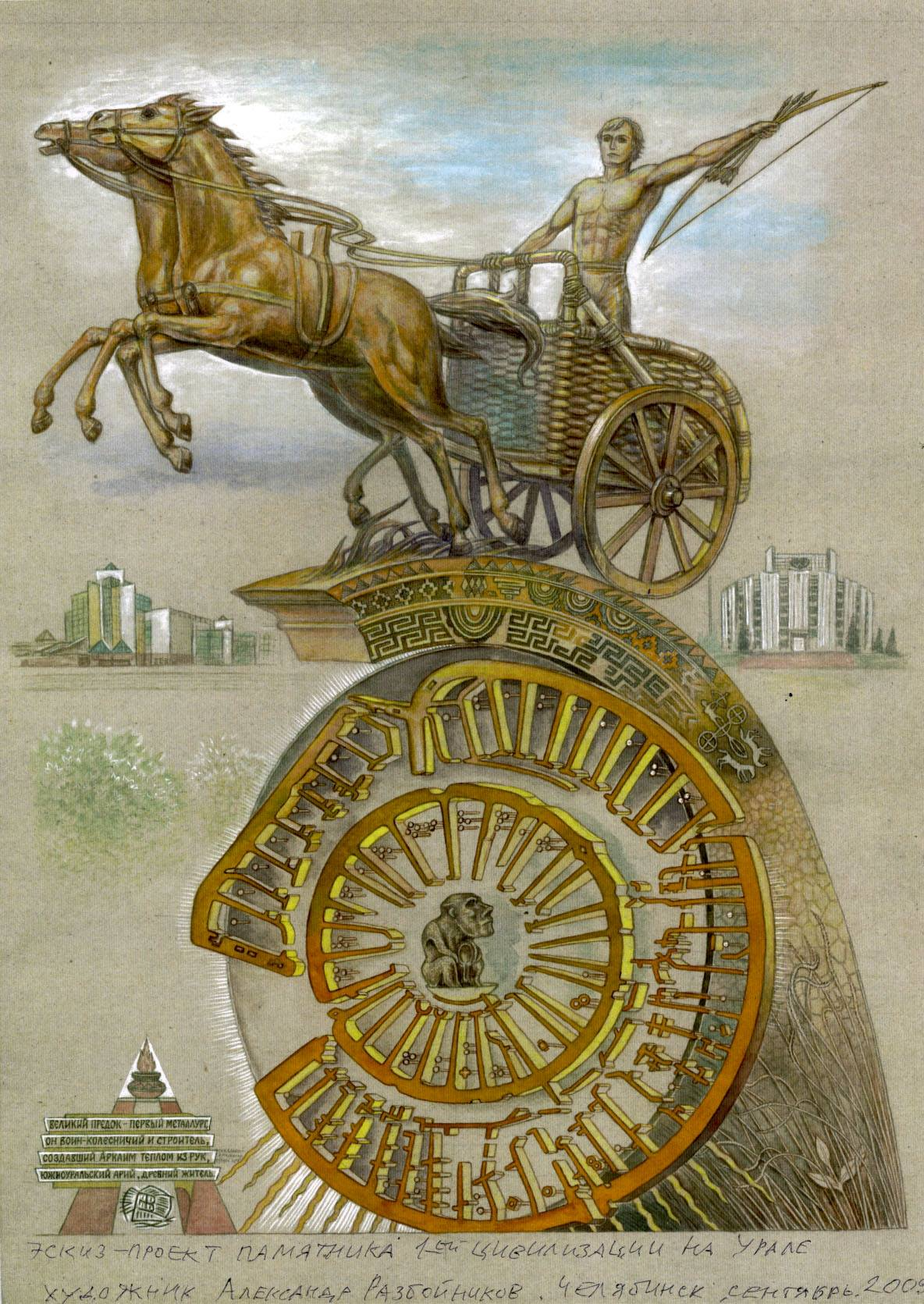
Far from the Middle East, a second group of humans escaped the fall. On the Eurasian steppe farming never took off, less efficient than herding in those seas of grass. Good was what worked, evil incompetence, and over generations, families maintained a single thread of consciousness in poetry and practice, represented by an eternal hearth fire, to forge the intellect to comprehend the world and the will to shape it — arete.
The root of the word survives in rationality, art, and reason, but also ritual and rite. To these people, who traced their ancestry to the mythical Manu, this was the highest divinity. To shape oneself to be free was the equivalent of religion, to be unbound by circumstances, to dominate them, in companionship with fellow free tinkerers, warriors, and explorers.
To domesticated humans the steppe seemed bizarre. Leaders were chosen by the elite in elections that lasted longest in the Germanic and Indic traditions. Their kings were quite limited in power, often seasonal, and may have had power arbitrating between the genuses, but never within them. Kings were often associated with ritual, but in the earliest layer, they are congratulated not for blind obedience to ritual, but for innovation, as the king is hailed as “finder of the way. He opens up the thought of our heart. Let a newer arete be born.” Associations between families with a hearth fire were voluntary, assumed through oaths sworn.
For equal in esteem to arete was a sense of natural freedom and liberty. Each person sought to be self-upheld, svadha, sovereign in his domain. And should necessity and privation not compel him, his rights would be recognized.
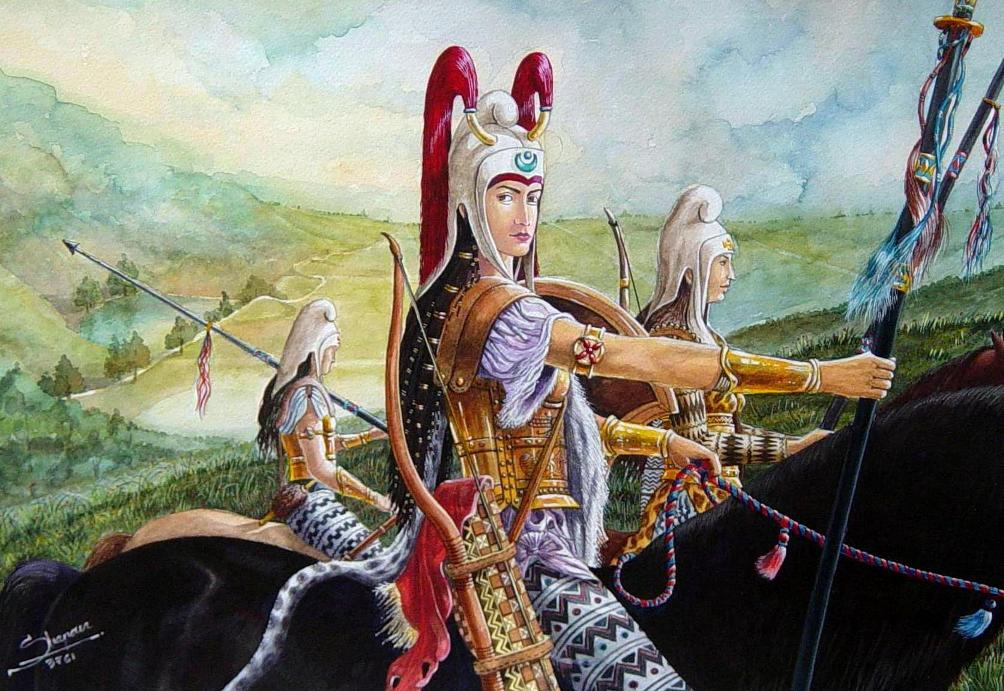
Sexuality was far more open and women were warriors and queens. Among the Scythians, their chief goddess, in a tradition where the chief deity was the most noted ancestor was the brilliant, beautiful, and belligerent Tapati. The Scythian queen Tomyris was the only ruler who could defeat Cyrus, who built the Persian Empire. The Celtic queen Boudicea would be their most remembered leader. And in accounts thousands of years later, Slavic and Germanic peoples would be nude together in warm springs, thinking nothing of their nudity, not sharing the shame of Adam and Eve.
As the children of the steppe expanded into the realm of farmers, they at first looked down on the Vanir and elves of the Northern European forest. We see this bigotry clearly as the Titan Loki scoffs at the elf Byggvir for being a “little creature” better suited for “muttering hard at the mill”, seeing to agriculture, than “set[ting] their shares of the meat for men” and attacking him as a coward who “hid in straw… when heroes were fain to fight.” To these Titans who lived for the hunt and war, the trappings of agriculture and civilization were seen as weakness and folly. For centuries, the people of the steppe who remained on the steppe kept themselves aloof from the farmers.
But far more interesting for the dawn of modern civilization was the synthesis of these two legacies, and each encounter would find new innovations born of these interactions. Often, the children of the steppe would intermix with the priesthoods and aristocrats of the farmers. This story is best captured by the theft of fire by Prometheus, who broke with the commandments of a steppe ruler to give to farmers the hearth fire and with it, the ability to be equals in the primeval city. Giving the fire he conferred on them rights, property, sovereignty, and the ability to engage on an equal footing in the enterprise of the children of Manu.
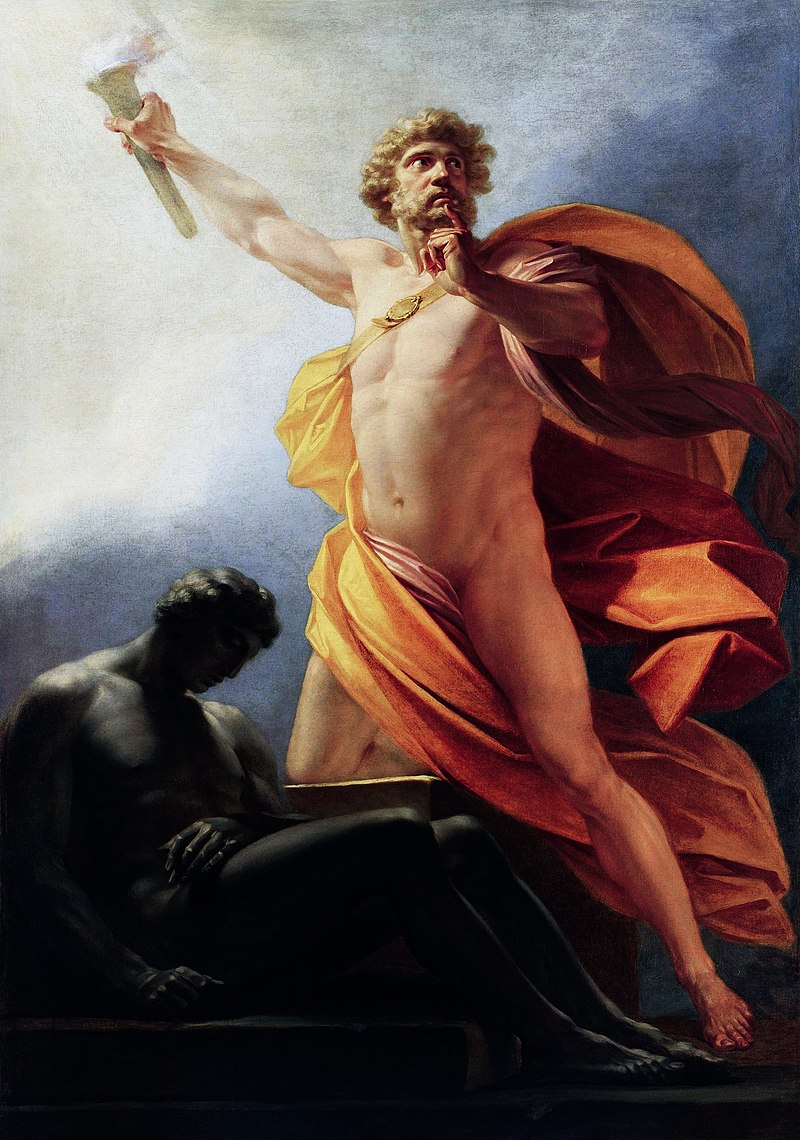
Prometheus represented a new openness that allowed a new civilization to expand across Eurasia, integrating where the Satanic complex had killed or subjugated. In northern Europe, the forest Vanir and farmer Elves joined in steppe society. In Greece, Rome, and the Middle East, hybrid societies were created. In India and Central Asia, the steppe joined with the farmer priesthood to create a new synthesis. Prometheus would pay dearly for this act. For as he created a new world, he angered a new steppe dynasty that had emerged. One king would sanction his actions, but the other would condemn him, chaining him to a rock for all eternity. Perhaps the son of the first king, Yima, was watching closely, for he would offer his own sacrifice in the name of civilization.
The synthesis of the steppe with the farming elites is best described as aristocratic rather than aretaic. At worst, they inherited the contempt for the domesticated classes, but the best societies, most notably the Romans, had a different approach. They believed in what they called - pietas, which the modern word piety doesn’t capture. While the aristocracy was skeptical of the superstitions of mass society, they also knew that goodness and virtue was encouraged by these superstitions and so, out of a respect for ordinary people, they made an outwards show of supporting and upholding these rites. Because, fundamentally, fallen man was not naturally evil and vicious, but needed a structure and system of traditional virtue to navigate the world, given that he was no longer wired for arete. But at its worst, most notably India, calcified caste, seen also with the Yazidis, defined the potential of humans by their ancestry rather than their arete.
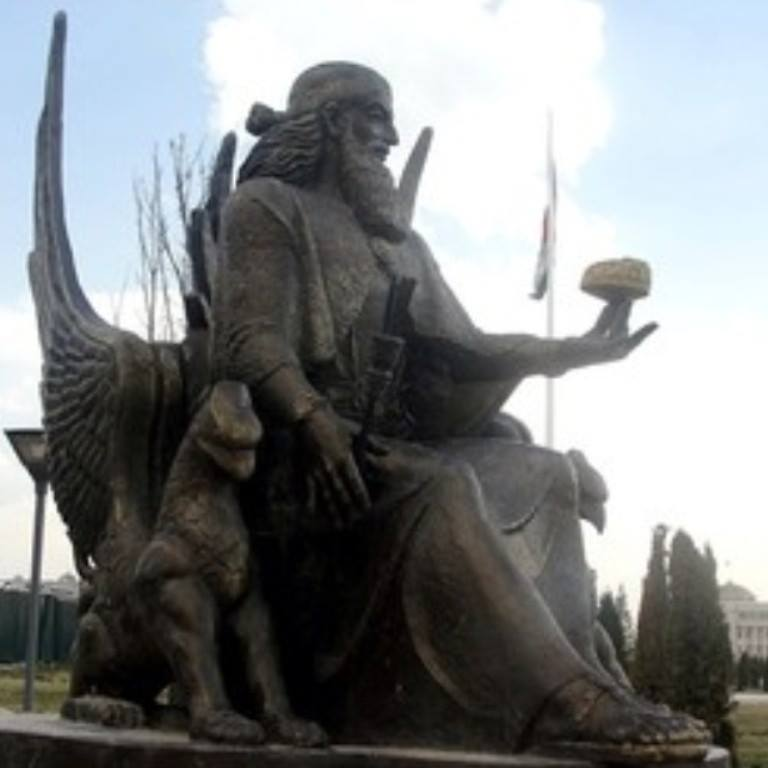
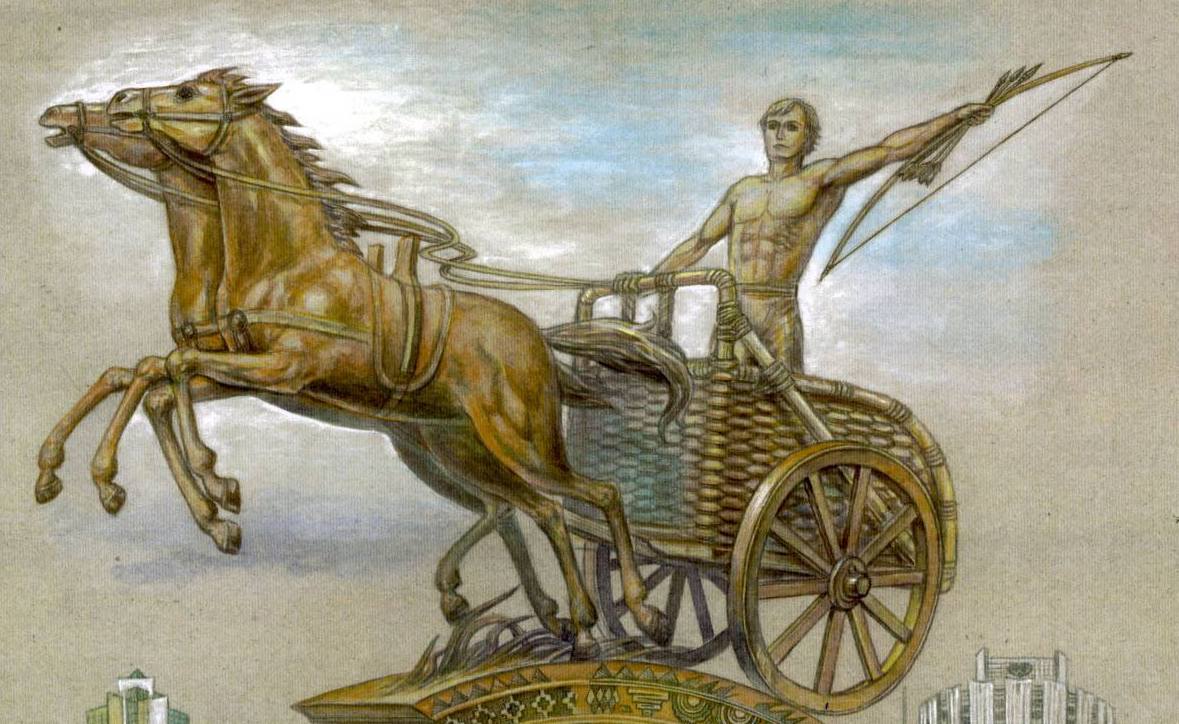
The second sacrifice was that of Yima, the Solar King, last monarch of the steppe. Faced with a cooling climate he drove wars of expansion that spread the chariot warriors of the steppe to the Mediterranean and Asia, but with time he grew disillusioned with his absolute power. He made a terrible choice — in a society that believed one’s afterlife was provided for by one’s children, he decided to not have any. This meant the equivalent of damnation, eternal starvation, but to him, the destruction of a central power that could strangle liberty was worth that ultimate sacrifice. In the great war that would follow, some would attempt to recreate the empire, but a warrior who was the bastard son of a royal lineage, remembered as Indra, Thor, and Zeus, would secure the freedom of the people of the steppe.
But even if the steppe people retained their sense of freedom, what of the people whose natures were mangled by smaller brain size and mimesis?
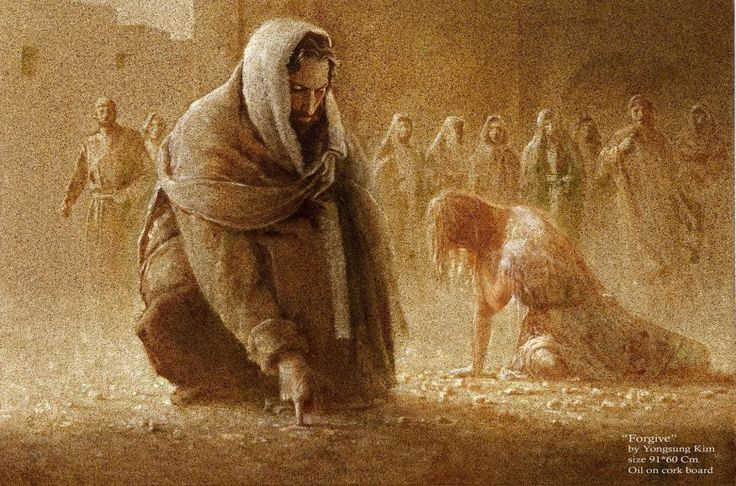
Jesus of Nazareth would transform their arc, finding a way to move beyond the mimetic trap. He found a path of transcendence of mimesis through embracing love and forgiveness of our neighbors’ sins, He divorced the church from the state. He stepped between the crowd bearing stones and a woman who had transgressed. He assailed the orthodox priests of his day. And, of course, he was murdered as a scapegoat. If you keep your reading to the Gospels, it is almost shocking how clearly he is a repudiation of the Satanic complex. He doesn’t try to lecture the fallen about arete, rather he gives them a framework to overcome the Satanic aspects of society given their fallen inheritance.
Thanks in large part to Paul, Christianity survives but as a continuation of the farmer complex. In its rise it almost wipes out aretaic civilization in Europe. As Hypatia is killed, Europe forgets arete and falls into a Dark Age. With the message of the gospels kept distant from ordinary people via priests murmuring in ancient tongues, Europe falls into the worst elements of the farmer complex.
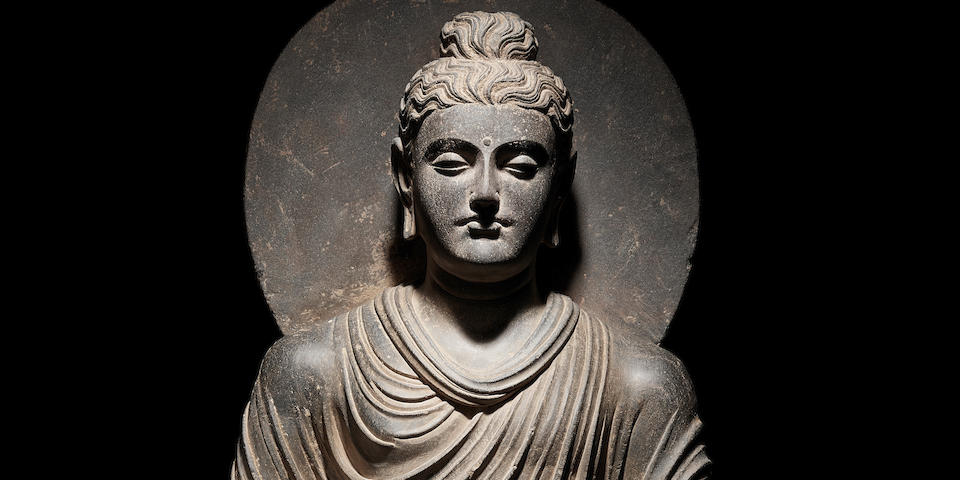
Arete goes to Central Asia where the eastern children of the steppe keep the flame burning. Adding the intellectual detachment of Buddhist thought to the axiomatic logic of Aristotle, they develop a system of algorithmic computation. It is no accident that our modern legal terms are Roman, our astronomical and geometric terms Greek, our algebraic terms named after Central Asians, and our numbers Indic. These various traditions are kept afloat across the children of the steppe, who still remember and uphold arete.
Islam wipes out arete in the East, but the crusades bring these ideas back to the West. Men like Adelard of Bath, travel far from Northern Europe to translate and preserve this knowledge, ensuring that arete will survive in its dimmest hour. To them we owe the deepest gratitude, and yet their names are almost universally forgotten.
Then Luther and his theological descendants start doing the unthinkable, translating the ideas of the Bible into the vernacular. Quickly, a revolution in theology happens. The authoritarian instinct remains in Paul’s work — he makes Christianity successful by adapting it to the aristocratic hierarchy. But, especially in northern England, the descendants of Vikings, recent converts, who have retained more egalitarian gender roles, decide they will listen only to the gospels.
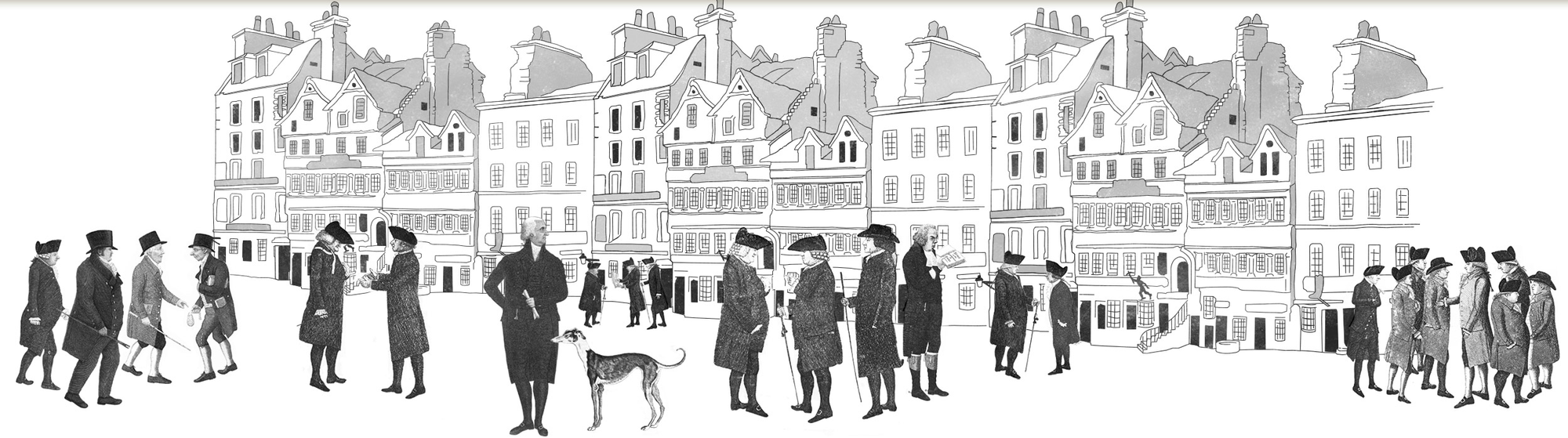
They preach a doctrine of the “inner light.” They believe humans are rational, but that this divine rationality can only be fully realized through grace. They are deeply skeptical of centralized power and love individual liberty. They eschew the priestly hierarchy of “useless knowledge” and prefer applied trades and crafts that can shape the world. Their Scottish cousins form a similar hybrid, creating the aretaic “Scottish Enlightenment” in which empiricism is the test of truth. This hybrid of steppe and Christian philosophy will form the United States, which will ultimately become the modern form of liberal thought.
The American revolution is a revolution of aretaic virtue — no masters, no slaves, the pursuit of excellence — against aristocratic norms — the old pietas and hierarchy of the Romans. It is unsurprising that much of the South was lukewarm about this revolution — their way of life was the same sort of agricultural feudalism as England. It was, perhaps, the first anti-Satanic state.
The revolution spread. The religious dimensions of liberalism are perhaps best captured in the battle hymn: “as he died to make men holy, let us die to make men free.” In the Civil War and then Two World Wars, the United States “made the world safe for democracy,” exporting it to all corners of the world.

But with Islamic terrorist, 9/11, Iraq, Afghanistan, and increasing economic inequality, it seemed that there was some sheer in the liberal model of reality. The sheer that emerged was from the belief that, deep down inside, everyone wants to be a rational shaper of the world. That every individual seeks arete and liberty. These ideals, rather than the unique product of a culture and ecology that was quite exceptional, were presented as human universals.
But deep within the human psyche, the disfigurement of Satan lurks. Much of the modern conundrum is what to do with Islam. It is almost a canary in the coal mine of the framework sheer of liberalism because it is, in many ways, the most perfect artifact of traditional farmer complex culture — religion = state? Check. Priesthood in liturgical language? Check. Leadership tied to birth? The crisis they have is the line broke — Check. Sexual restriction of women? Check.
The mistake we often make is that we assume intelligence is tied to whichever cultural context we subscribe to. But there are smart and dumb people of both farmer and aretaic natures. So it is not an accident when educated Islamists are more radical than ordinary Islamists — in the frame of their cultural complex, they are expressing a higher awareness and agency. We cannot impose aretaic values on others.
Our hearts break when we hear of individuals seeking this arete, confined by the norms and mores of the old farmer complex. We want to do something to allow them to flourish. But what we ignore is that actually, this aretaic culture was destroyed there, systematically, as it had been in Europe earlier. And rather than inevitable, there is something deep in the human psyche that seeks to destroy it. There is a real tension, and finding a harmony between the two is what brought us civilization.
You can hear the frame dissonance in our language. To farmers, the aretaic are “pretentious” for loving say, classical music, poetry, or complex sentence structure. It never occurs to them (1) the impact of these things on the moving of their mind may be genuinely appreciated and (2) that people may love something for reasons other than social proof. To them, they think people are genuinely pretending, because they cannot imagine that they would love these things for its own sake. Similarly, when farmers seek tradition, religious piety, and an honorable life in line with social norms, the aretaic may think it is because they are uneducated or oppressed. It never occurs to them that they may be doing these things because it gives them a deep fulfillment.
The modern left and right both have aretaic and farmer elements. Socialism and fascism are modernist farmer complexes: There is an evil elite! They have succeeded not because they are good but because they play evil tricks! Their wealth is from exploiting you! Because of this, they are powerful and so the only way to deal with them is to trust us! For we are righteous and will use centralized authority for good reasons!
Read the pages of Breitbart on anything or the New York Times talking about Elon Musk and you can see the outlines of these arguments. In an article where the headline is “Elon Musk left a South Africa that was Rife with Misinformation and White Privilege”, the facts are indeed presented that (1) his dad was an anti-apartheid politician, (2) he fought to protect bullied black kids are in the article, but presented in a way to muddle the obvious conclusion. Musk embodies arete, indifferent to pietas, ever chasing the horizon, and it’s not surprising both Bannon and the New York Times hate him.
Today we live in a world where the eternal flame of arete may not survive, besieged on both the right and the left. And to quote Reagan, “if we lose that war, and in so doing lose this way of freedom of ours, history will record with the greatest astonishment that those who had the most to lose did the least to prevent its happening.” No one else is coming. It is up to us. To ensure the survival of arete, or failing that, to find a new frontier for its survival.